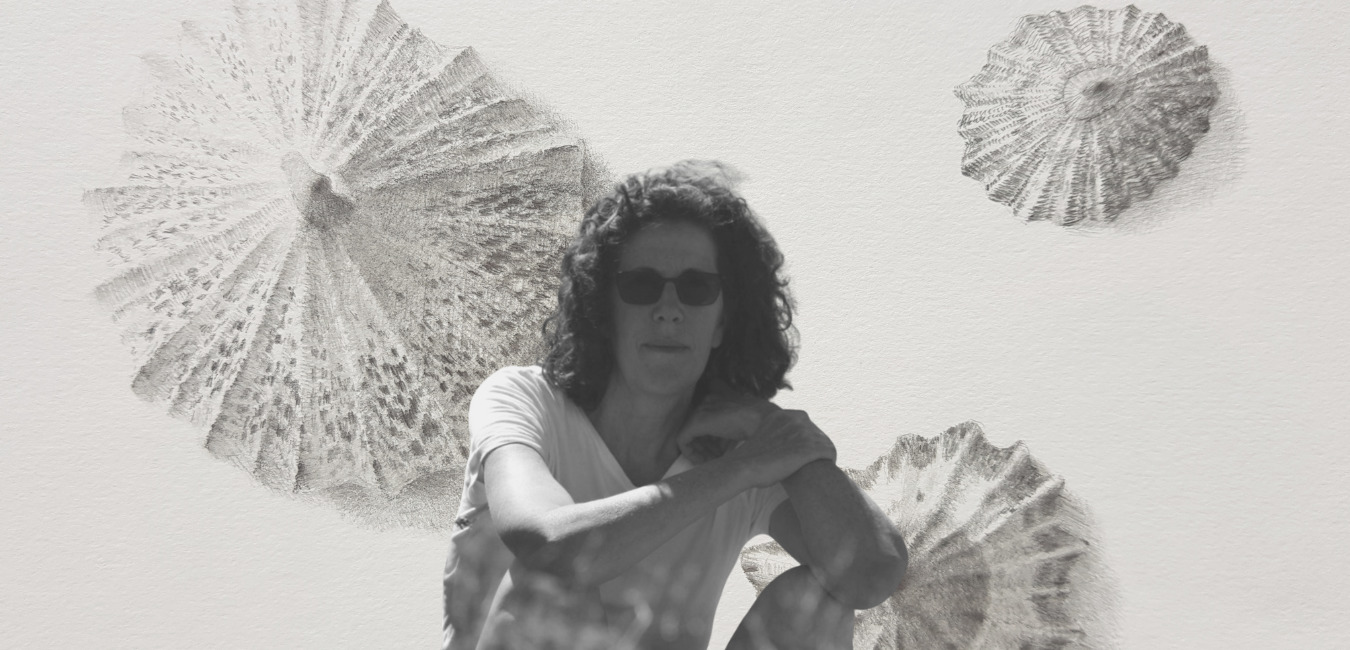
Karin Daymond is the sort of person who is tickled with delight when she comes across three small and lovely stones wrapped in a sock in her luggage on her return from a holiday.
She can’t recall a time when she wasn’t gleaning found treasures. “I was born and grew up in Durban. My family spent every weekend at our cottage, well it was more like a beach shack that grew with the family, at Sheffield. That was really my ‘place.’ My sisters and I ran wild. I loved the beach. I’ve always been an obsessive collector of shells, stones, all sorts of tiny beautiful things.”
The day I speak to her she has swum up for air after being submerged in the pattern made by the lines on a shell she carried back to her inland home from a recent trip to the coast. “I’m a person who pays close attention to things that others may not notice. I’ve spent hundreds and hundreds of hours looking closely at things. Over time this has built up multiple layers of visual knowledge. As I’m drawing I’m deconstructing and reconstructing details on paper.”
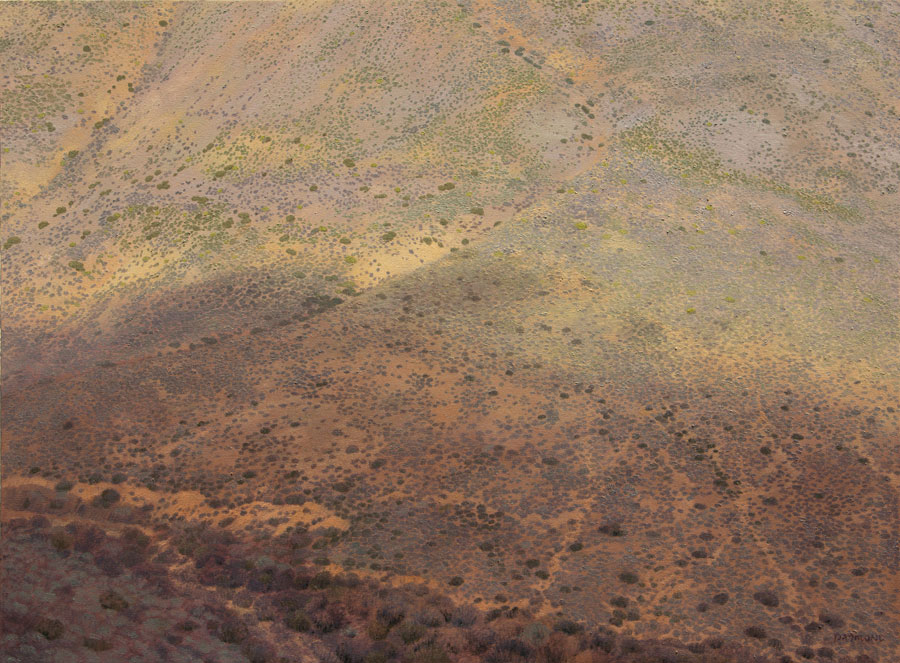
The artist’s piercing attention translates to her canvases. Her work has mesmerized me since I first saw her paintings of gauzy rock pools, ragged kloofs and arid vistas where the light picks its way among slopes and outbursts of rock.
Seeing them, your inner knowing prickles because you perceive at once that you’re gazing not at an aloe-mottled landscape or the microscopic chartreuse miracle of lichen, but into the numinous.
Sketching background
Having grown up in an English province, the young Karin moved to join her now-husband in a predominantly Afrikaans part of the country where they still live. They raised a family and established productive happy lives, but it wasn’t always an easy or satisfying fit. For a long time after she first arrived she felt socially ostracized for being an outsider and she grappled with the culture and language. “It was a very different place and it’s changed a lot since, but I couldn’t even join the library because I didn’t have the local references you needed in those days. There was very little I could do except walk and paint.”
“I immersed myself in the landscapes,” she says.
You picture her as a rangy young painter, now far from her warm ocean, charting the Lowveld’s ancient, baobab etched map to gather its pattern and testimony.
“Looking back I can see that one of the advantages of coming here was that I was alone and left to my own devices. It was my escape, and it set me on the path to finding my way as an artist.”
“Moving here led me to discover that landscape is my true realm.”
Back to source
In time she found her feet, sent up green shoots and opened a teaching studio. “I grew to love it here and I also really love that my classes made a difference in people’s lives. I learned a lot about myself and teaching helped me grow technically.” As many artists well know, teaching and their own work are most often debit and credit columns.
For Karin, after 17 years of teaching, she took stock. “I woke up and thought whoa, what about my own painting? I remember walking into the kitchen and saying to my husband, that’s it. It was a turning point. I stopped teaching. I’d been producing work prior to that but to be an artist takes 150% of everything you’ve got.” You sense a world of private struggle shielded by vast understatement. “The trouble is, I’m highly porous which is actually a good thing, and necessary because an artist cannot have thick skin. But it’s difficult.”
As ever, the landscape – every scar and hollow, lilt and wound of it – is her remedy.
“Lately I’m interested in seeing how we make marks on the land, how it’s delineated by fences and paths. I don’t paint figures. They immediately dictate the picture. I’d prefer to try to get my viewer to find their own way into the painting.”

You belong here
Welcome Stranger, her moving series on migration, is the closest she comes to incorporating figures. The pieces suggest the presence of people without showing them. In her website journal, she writes,
“I asked myself what I would take if I had to leave. African women take fabric. I scattered my collection of African fabrics on the floor and painted them as if lost at sea. Every cloth is regional and has meaning. With it around her, a woman can seem regal and even happy. She might even feel these things. These flashes of colour push back despair; they conceal and express at the same time.”
“That is probably one of my most heartfelt bodies of work. Overall I find that if I make something I was supposed to make it goes well. That’s why I don’t do commissions. It has to come from inside, and be done with heart and integrity.”
Everything about her work calls the viewer to examine belonging and relationship to the earth.
“The landscape is intrinsic to all of us, but most people aren’t aware of what makes them feel connected to a place. I’ve taken a long visual journey in an attempt to understand this.”

About the artist: Daymond was born in 1967 in Durban, South Africa. She obtained a Bachelor of Fine Art from The University of KwaZulu-Natal and now lives and works in Nelspruit, Mpumalanga. Daymond has exhibited extensively with 10 solo exhibitions and numerous group shows. She has a core of loyal devotees and her works are included in many public and private collections in South Africa and internationally. Read more on her website: www.karindaymond.co.za and follow her on social media via Instagram @karindaymond